
Picture this: you’re a CSM at a growing SaaS company. You’re juggling 80 accounts across a team of four, tracking everything in a spreadsheet that’s slowly becoming a liability, and watching churn signals slip through the cracks. You know you need a proper customer success platform. You book a demo with Gainsight, get a quote back, and nearly fall off your chair.
It’s a scenario that plays out constantly in the Customer Success community. The platforms that dominate industry conversations are built for enterprise teams with dedicated CS Ops staff and six-figure software budgets. But what about the rest of us — teams of two to ten CSMs managing a fast-growing book of business on a budget that needs to stretch across tools, headcount, and everything in between?
This guide cuts through the noise. We looked at what CS professionals are actually asking for — real visibility, health scoring that works out of the box, automation that doesn’t require a three-month implementation project — and matched those needs to platforms that can genuinely deliver. No enterprise overhead required.
Why Most CS Software Comparisons Miss the Point for Small Teams
The typical “best customer success software” roundup ranks Gainsight at the top and works its way down from there. That framing is fine if you’re a Head of CS at a company with 200+ enterprise accounts and a CS Ops specialist on staff. For everyone else, it’s like recommending a commercial kitchen when you just want to cook dinner.
The reality is that small CS teams have fundamentally different requirements. They need a platform that a CSM can actually configure themselves, not one that requires an implementation partner. They need pricing that scales with their customer base rather than locking them into a five-figure annual commitment before they’ve validated the tool. And they need time-to-value measured in days or weeks, not the three-to-six months that enterprise platforms typically demand.
According to industry research, 75% of teams looking to switch from enterprise platforms cited cost as their primary driver in 2026, while 60% said they needed more customizable features that actually fit their workflows rather than forcing their team to adapt to the software’s assumptions. Those numbers tell a clear story: the market for enterprise CS tools is saturated with complexity that most teams simply don’t need.
What a Small CS Team Actually Needs from a Platform
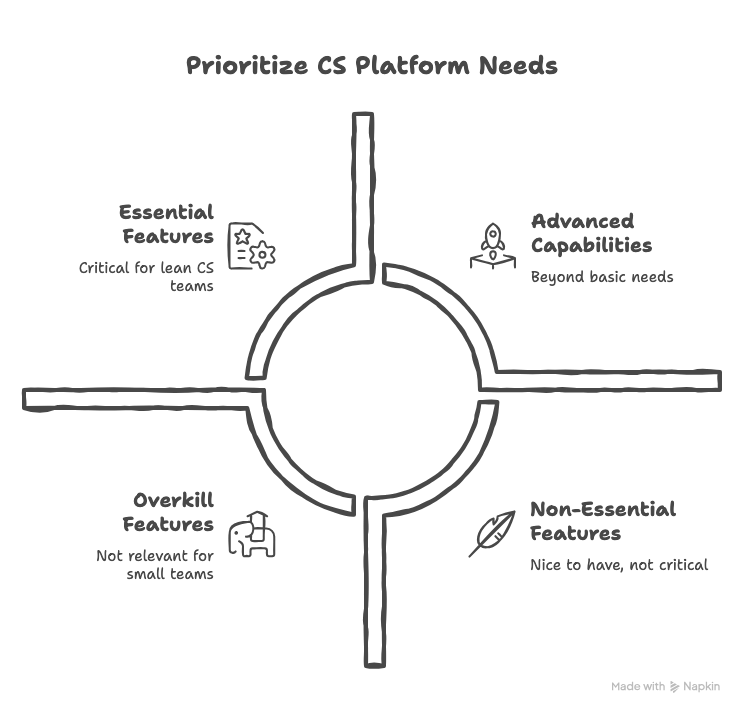
Before evaluating any specific tool, it helps to get clear on the four things that genuinely move the needle for lean CS teams.
Customer health scoring that surfaces signals automatically. The whole point of a CS platform is replacing the gut-feel approach with data. Health scores need to pull from product usage, support tickets, CRM activity, and billing data to give CSMs an accurate, real-time picture of every account. If you’re still manually checking in with accounts because your tool doesn’t surface risk, you haven’t actually solved the problem.
Automation that handles the routine so CSMs can focus on what matters. A two-CSM team managing 150 accounts cannot send personalized check-ins to every customer manually. Automation that triggers outreach based on usage drops, milestone completions, or renewal proximity is the multiplier that lets small teams punch above their weight.
Integration with your existing stack without custom engineering work. Your customer data lives in your CRM, your support tool, your product analytics platform, and your billing system. A CS platform that can’t pull cleanly from those sources creates yet another siloed view rather than solving the visibility problem. Native integrations with HubSpot, Salesforce, Intercom, Stripe, and Segment are table stakes in 2026.
Pricing that reflects where you actually are, not where you might be in five years. Committing to a $30,000 annual contract when you have a team of three and 200 customers is a bad bet. The platforms worth considering for small teams either offer transparent per-seat pricing or usage-based models that grow in step with your business.
The Best Customer Success Platforms for Small Teams in 2026
1. Custify — Best Overall for Small and Early-Stage Teams
Custify has built its entire identity around the gap between spreadsheet-based CS management and enterprise platforms that require dedicated admins to function. The result is a platform that a CSM can genuinely configure themselves, get running in weeks rather than months, and actually use as part of their daily workflow rather than treating it as a reporting tool they check once a week.
The core value proposition is straightforward: pull product usage, support tickets, CRM data, and billing history into a single account view, then use that unified picture to build health scores and trigger automated playbooks. Custify’s onboarding support is consistently flagged in user reviews as a genuine differentiator — the team helps you configure the platform to match your actual workflows rather than asking you to adapt to a default template.
Where Custify falls short is in advanced analytics. Teams that need deep predictive modelling or AI-driven expansion signals will hit the ceiling of what the platform can offer. But for teams of two to ten CSMs who are ready to move off spreadsheets and need core CS functionality running fast, it’s the strongest starting point on this list.
Best for: Small SaaS teams (2–10 CSMs) transitioning from spreadsheet-based account management
Pricing: Starts at approximately $399–$899/month depending on account volume and features
Setup time: 1–4 weeks
2. Vitally — Best for Fast-Growing Teams That Want Modern UX
Vitally takes a different philosophy to the CS platform problem. Where legacy tools were built primarily as reporting dashboards that CSMs check periodically, Vitally is built around the idea that CSMs should live in the platform as part of their daily workflow. The result is a workspace-centric interface where health scores, tasks, notes, and account analytics all coexist in a single unified view.
The collaboration features are particularly strong. Vitally Docs allows teams to build shared success plans that both internal stakeholders and customers can access directly within the platform — something that most CS tools still require you to handle through a separate tool like Notion or Google Docs. The playbook automation engine is genuinely powerful, supporting branching logic that rivals what you’d find in more expensive enterprise tools.
The trade-off is cost and complexity at the lower end. Vitally starts at around $499/month for smaller teams, which is accessible, but the full feature set requires a platform investment that may feel heavy for a solo CSM or a team just starting to formalize their CS processes. Teams at Series A or beyond will find the price-to-value ratio excellent; teams earlier than that may want to start with Custify and migrate later.
Best for: Fast-growing SaaS teams (Series A–C) prioritising modern UX and collaborative success planning
Pricing: From approximately $499/month; scales with team size
Setup time: 1–3 weeks
3. Totango — Best Free Entry Point for Early-Stage Teams
Totango is unique on this list for offering a genuinely functional free tier — not a 14-day trial, but an ongoing free plan that gives early-stage teams basic health scoring and customer segmentation without any upfront cost. For a team that’s still building its CS function from scratch and isn’t ready to commit budget to a dedicated platform, this is a meaningful option.
The platform’s SuccessBLOCs system is its most distinctive feature — pre-built workflow templates for common CS scenarios like onboarding, adoption, and renewal that teams can deploy immediately and customise over time. This modular approach means you can start with the pieces most relevant to your current stage and add complexity as your program matures.
As teams scale past 20 CSMs, Totango’s positioning shifts toward mid-market and enterprise territory, and pricing follows accordingly. But as an entry point for a team that needs to start tracking customer health today without a procurement process, it deserves serious consideration.
Best for: Early-stage teams that need to start immediately without budget commitment
Pricing: Free tier available; paid plans scale with usage
Setup time: Days to 2 weeks
4. ClientSuccess — Best for Relationship-Focused CS Teams
Not every CS team is running a product-led growth model where usage data is the primary health signal. Many B2B SaaS companies — particularly those with longer sales cycles, enterprise relationships, or professional services components — operate in a model where the quality of the human relationship is what drives retention. ClientSuccess was built for exactly that context.
The platform’s Pulse system is a standout feature: a quick, standardised way for CSMs to log qualitative account health observations alongside the quantitative data that health scores typically capture. This matters because a health score that shows green on product usage can still mask a relationship that’s quietly deteriorating. Combining the quantitative and qualitative picture gives CSMs a more complete and accurate view of where each account actually stands.
Implementation is notably fast compared to other platforms at a similar feature level, typically measured in days or weeks rather than months. For mid-market teams that value daily usability and quick time-to-value over advanced customisation or enterprise-grade analytics, ClientSuccess hits a strong balance.
Best for: Mid-market teams where relationship quality is the primary retention driver
Pricing: Similar range to Custify; contact for specifics
Setup time: Days to 3 weeks
5. HubSpot Service Hub — Best for Teams Already in the HubSpot Ecosystem
If your team is already running HubSpot as your CRM, the case for looking outside the ecosystem before you’ve exhausted what Service Hub can offer is weak. The integration is native and frictionless — customer data, interaction history, pipeline records, and support tickets all live in one system without the connector overhead that every other platform on this list requires.
Service Hub’s CS capabilities have matured significantly in recent years. Health scoring, usage analytics integration, automated touchpoints, and NPS collection are all available at price points that are substantially lower than dedicated CS platforms. For budget-conscious teams that don’t need the specialist depth of a purpose-built CS tool, this is the most pragmatic starting point.
The honest caveat: Service Hub is a solid generalist, not a specialist. Teams that need sophisticated health scoring built on granular product usage data, or complex multi-step playbook automation, will hit its limits and eventually outgrow it. But as a first CS platform for a team already in HubSpot, it removes most of the friction and cost of getting started.
Best for: Teams already using HubSpot CRM who want integrated CS functionality without a separate tool
Pricing: From $15/seat/month on Starter; Professional tier recommended for CS use cases
Setup time: Days if already in HubSpot
A Word on Gainsight and ChurnZero
No CS software guide is complete without addressing the two platforms that dominate most enterprise conversations. Gainsight is genuinely the most powerful platform in the category — for the right team. If you’re managing hundreds of enterprise accounts with multiple products, need deep Salesforce integration, and have a CS Ops specialist available to configure and maintain the system, Gainsight’s depth is unmatched. But implementation typically runs three to six months, pricing starts around $30,000 per year for modest teams and scales quickly from there, and the platform’s complexity requires ongoing admin investment that lean teams simply can’t justify.
ChurnZero sits in a more interesting position — purpose-built for subscription businesses with strong real-time health scoring and automated plays, and a more intuitive interface than Gainsight. For mid-market SaaS teams of 20 or more CSMs with dedicated CS Ops support, it’s a strong choice. For smaller teams, the pricing (typically $1,500/month and up) and implementation requirements still place it out of reach.
The bottom line on both: they’re excellent tools for the teams they were designed for. A team of four CSMs doesn’t need — and can’t fully use — what either platform offers. Choosing the right tool for your actual stage beats choosing the most impressive tool for a stage you haven’t reached yet.
How to Evaluate Before You Commit
Most CS platforms offer a trial or a structured proof-of-value period. Before signing anything, run a real end-to-end workflow through the platform — not a sanitised demo environment, but your actual customer data, your actual health score inputs, and a playbook that reflects how your team genuinely works. The platforms that surface value quickly are the ones worth committing to.
Ask these questions before any sales conversation turns into a contract:
- How long until our first actionable insight after data connection? If the answer is “after implementation completes,” treat that as a red flag.
- Which integrations are native versus connector-based, and what does connector maintenance look like at renewal?
- What does the admin overhead look like at 6 months — do we need a dedicated ops person to keep this running?
- How does pricing change as our customer base doubles? Get the scaling model in writing.
- What does the offboarding process look like if we need to migrate to another tool in two years?
The platforms that answer these questions clearly and without hesitation are the ones that have built their product for teams like yours. The ones that deflect or push you toward another discovery call deserve more scrutiny before you proceed.
The Right Tool Is the One Your Team Actually Uses
There’s a simple measure of whether a CS platform is working: are your CSMs logging into it every day and making decisions based on what they see? A sophisticated enterprise platform that CSMs work around because it’s too complex to navigate quickly has failed, regardless of what it looked like in the demo. A simpler tool that your team actually uses to prioritise their accounts, trigger timely outreach, and catch churn signals before they become churn events is delivering real value.
For most small CS teams in 2026, that tool is Custify, Vitally, or HubSpot Service Hub — depending on your stage, your existing stack, and whether you need specialist depth or integrated simplicity. Totango’s free tier gives you a genuine entry point if budget is the primary constraint. ClientSuccess deserves a look if your model is relationship-led rather than product-led.
The right platform is not the most feature-rich one, or the one with the best G2 score, or the one your investors’ portfolio companies use. It’s the one that fits your current team size, your workflows, and the way your customers actually behave — and gets out of the way so your CSMs can do the work that matters.
Frequently Asked Questions
What is the most affordable customer success platform for a small team?
Totango offers the only genuine free tier among established CS platforms, making it the lowest barrier entry point. For paid platforms, Custify and HubSpot Service Hub offer the strongest value at accessible price points for teams under 10 CSMs.
Do small teams really need a dedicated CS platform, or can a CRM handle it?
A CRM manages pipeline and stores records; it doesn’t proactively surface churn risk or trigger automated retention plays. Once you’re managing more than 50 accounts per CSM, a dedicated platform’s health scoring and automation becomes difficult to replicate manually. The crossover point for most teams is when spreadsheet management starts visibly costing you accounts.
How long does it take to implement a CS platform for a small team?
Lightweight platforms like Custify, ClientSuccess, and HubSpot Service Hub can typically be configured and operational within one to four weeks for a small team. Enterprise platforms like Gainsight and ChurnZero involve implementation projects that commonly run two to six months, including data migration and workflow configuration.
Is Gainsight worth it for a team of under ten CSMs?
In most cases, no. Gainsight’s depth of features is designed for teams managing complex enterprise portfolios with dedicated CS Ops support. The implementation timeline, ongoing admin overhead, and pricing model are structured for organisations that have the resources to fully leverage the platform’s capabilities. Teams under ten CSMs will typically find better value in a platform built for their scale.

Leave a Reply