

It’s a post that could have been written by almost anyone in Customer Success right now: “I’ve left a few roles recently depleted. This job market is brutal. I’m so tempted to quit but not sure what to pivot to. I’ve been doing this for 5 years and I feel like the role is exploited. Too many hats and no support is leading me to burnout. My hair is falling out.”
This is a real account from a real Customer Success Manager, shared recently in the r/CustomerSuccess community. It struck a nerve. Dozens of experienced CSMs responded — some who’d been in the role for 10 to 15 years, some who’d already made the leap out, and others who were quietly fighting the same battle from the inside.
If any part of that opening resonates with you, this article is for you. We’re not going to sugarcoat the CSM experience or pretend that a mindset shift will fix a structurally broken role. Instead, we’re going to give you what that Reddit thread gave thousands of CSMs: honest, experience-backed perspective on what’s happening, whether you should quit, how to protect yourself if you stay, and where your skills can take you next.
Why So Many CSMs Are Burning Out Right Now
Customer Success Manager burnout is not a personal failure. It is a structural problem baked into how the role has evolved — and how companies continue to misuse it.
When CSM roles first emerged in the SaaS boom of the 2010s, the remit was relatively clear: help customers adopt the product, demonstrate value, drive renewals. But over the past several years, that scope has expanded dramatically without a corresponding increase in authority, headcount, or compensation. Today’s CSM is often expected to be an onboarding specialist, a technical troubleshooter, an account executive, a project manager, a product consultant, a data analyst, and an executive relationship owner — all simultaneously, across dozens of accounts.
One comment from a 10-year CSM veteran captures it precisely: “We are responsible for everything but have no authority for anything. We’ve been set up to fail.”
That phrase — responsible for everything, authority over nothing — surfaced repeatedly in that thread, resonating with CSMs across industries and experience levels. It describes something that goes beyond a heavy workload. It describes a structural trap: you own customer outcomes, but you cannot control product roadmap decisions, pricing, engineering timelines, or support response times. When a customer churns, the CSM is accountable. When a deal expands, the credit often flows elsewhere.
The emotional labor dimension compounds the problem. Customer Success, almost by design, attracts people who genuinely care. Empathy and relationship-building are not just desirable traits in this role — they are requirements. But those same qualities create vulnerability. As one comment noted: “The CSM role naturally pulls in people who care — it can make you a great CSM, but it is also dangerous to your mental health.”
Add a brutal job market, widespread layoffs in tech, and companies squeezing more out of smaller CS teams, and you have a perfect storm for the kind of burnout that doesn’t just make you tired — it makes your hair fall out.
Should You Actually Quit? What Experienced CSMs Say
The most consistent piece of advice from the entire thread — from CSMs with two years of experience to those with fifteen — was this: do not quit without something lined up first.
That is not just cautious advice. It is advice grounded in hard, firsthand experience. One senior CSM who left a well-known database company described what happened next: “I quit thinking the company name would get me a job easily — boy, was I wrong. Took me a year to finally land something. I interviewed with over 70 companies, four to six rounds each, and fell short in the last round more times than I can count.”
Another CSM described interviewing with a company, sending a thank-you email after the first round — and having it bounce back because the interviewer had been laid off the following day.
This is the market CSMs are navigating right now. The job boards may show openings, but the interview processes are long, the competition is intense, and the instability at many companies means that a role you accept today may not look the same in six months.
The practical consensus: stay employed while you search. Use the job as your financial base while you build your exit. Treat the search as a parallel project — structured, intentional, and patient.
One Exception Worth Considering
Several CSMs in the thread mentioned a specific exception: if your health — physical or mental — is genuinely deteriorating, the calculation changes. One CSM who moved from health tech to a nonprofit described it plainly: “I did take a pay cut, but honestly my health was actually suffering as a CSM so I had to make a move. It’s such a more balanced, reasonable workload. I literally don’t know how I was managing in CS.”
If you are at the point where work is causing physical symptoms — persistent illness, hair loss, insomnia, anxiety that doesn’t resolve on weekends — that is a signal that should not be ignored. No job is worth that cost. In those circumstances, the right move might be exploring options like FMLA leave (in the US) to create a buffer while you search, rather than either grinding through or quitting cold.
How to Protect Your Mental Health While You’re Still in the Role
If leaving immediately isn’t feasible — and for most people it isn’t — the question becomes: how do you survive without losing yourself in the process?
The advice from the community isn’t about toxic positivity or pretending the role is fine. It’s about deliberately recalibrating your relationship with work.
Redefine What the Job Actually Requires of You
One of the most grounding reframes in the thread came from a CSM who’d been in the role for a decade: “Your job isn’t to fix everything. It is to be the voice of the customer within the business. That is all.”
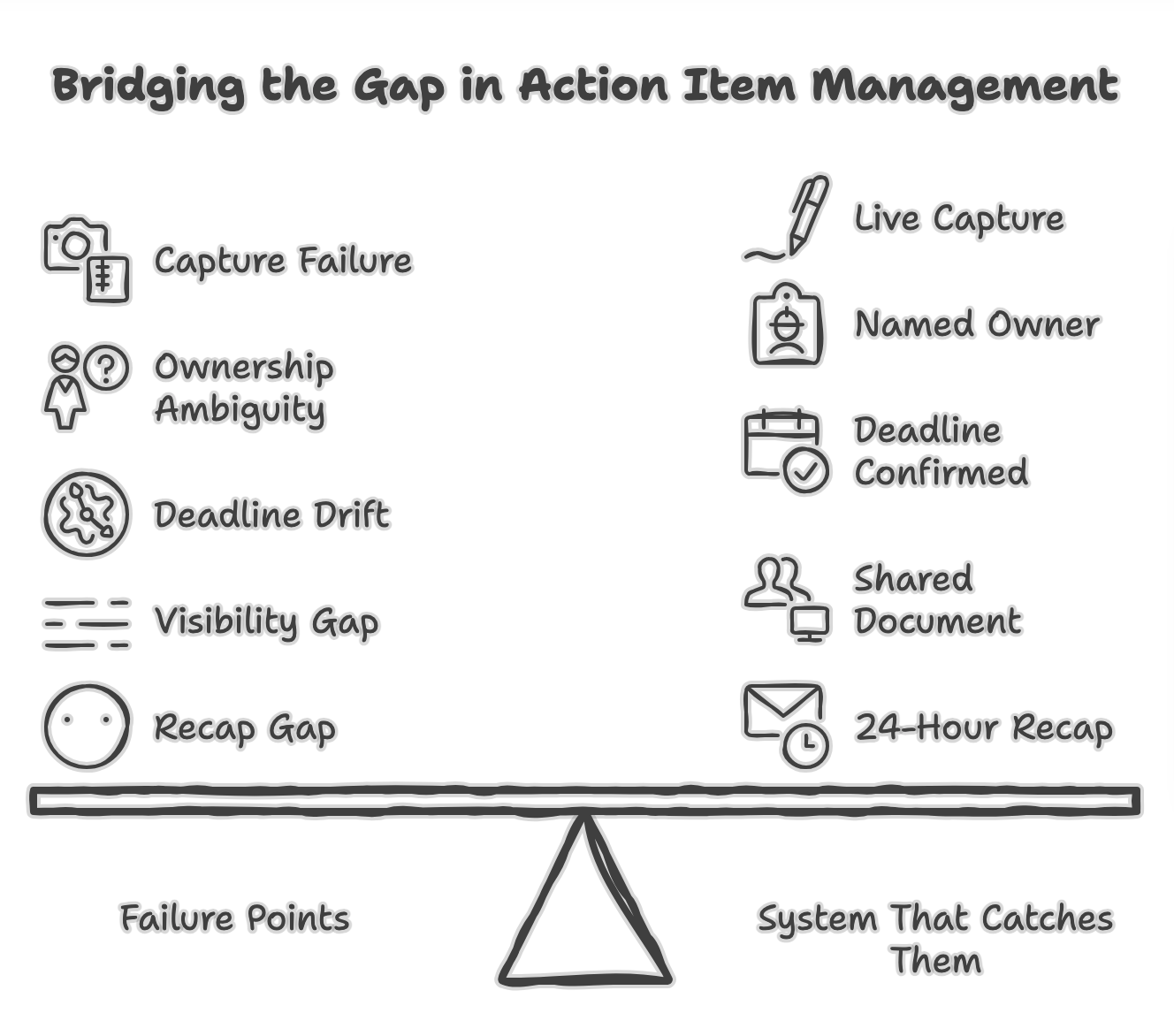
When you carry responsibility for everything — customer outcomes, product gaps, support failures, internal miscommunication — you are carrying weight that was never meant to be yours alone. Getting specific about what is actually within your scope, and letting go of what isn’t, is not laziness. It is self-preservation and, paradoxically, it often makes you a more effective CSM. Part of that scoping work is building a small set of systems that catch the operational stuff reliably so it stops eating your headspace — our guide to why action items slip between weekly check-ins and how to build a system that catches them walks through the practical mechanics.
Stop Taking It Personally
This is harder than it sounds for people who care, but it is arguably the most important shift. Customers who churn, executives who go dark, escalations that blow up — these are not reflections of your worth or competence. They are outputs of a complex system in which you are one variable among many.
A veteran CSM put it plainly: “What helps keep whatever sanity I have left is to simply stop caring and to not take it personal anymore.” That doesn’t mean becoming indifferent — it means building an internal boundary between your professional performance and your self-worth.
Draw a Hard Line on Work Hours
CSMs who check Slack at 10pm, respond to customer emails on weekends, and skip lunch to handle escalations are not performing better — they are depleting faster. The work will always expand to fill the time you give it. Protecting your personal time is not negotiable; it is what allows you to show up with any quality the next day.
Set a clear end to your workday and hold it. Communicate response time expectations to customers rather than training them to expect instant availability. These are not radical demands — they are basic professional norms that the CSM role has somehow normalized away from.
Build Your Exit While You’re Still Employed
One of the most practical pieces of advice in the thread: use this period not just to survive, but to build. Update your LinkedIn. Document your wins — NRR improvements, churn you prevented, expansions you drove. Start having quiet conversations with your network. Apply selectively but consistently. Having a live search running changes how you experience your current job because you know it’s not permanent.
The Best Roles to Pivot Into from Customer Success
One of the most valuable things a CSM who’s burning out can recognize is this: the skills you’ve built are genuinely rare and transferable. Five years of managing complex accounts, navigating executive relationships, translating product value into business outcomes, and operating under pressure without breaking — that portfolio opens more doors than most people realize.
Here are the roles the community consistently recommended, along with why they’re a natural fit:
Technical Account Manager (TAM)
This is the most frequently cited pivot and for good reason. TAMs handle many of the same relationship and account management responsibilities as CSMs but typically sit closer to the technical side of a product. The scope tends to be more clearly defined, the career path more established, and the compensation often higher. If you’ve developed any technical fluency alongside your relationship skills, this is the clearest on-ramp.
Solutions Engineer / Solutions Consultant
CSMs who are comfortable presenting, demonstrating, and translating product capabilities into customer-specific use cases will find Solutions Engineering familiar territory. The role sits pre-sale rather than post-sale, which means you’re building momentum rather than holding the line — a shift that many burned-out CSMs find refreshing.
Customer Success Enablement
If you enjoy the coaching and process-building sides of CS more than the day-to-day account management grind, enablement is a natural evolution. You’d be building playbooks, training new CSMs, and improving the systems that make CS teams function — drawing on everything you’ve learned while stepping back from the front-line emotional labor.
Customer-Facing Product Manager
Years of translating customer feedback into internal language and advocating for product changes is essentially a core PM competency. CSMs who’ve been the bridge between customers and product teams have built a foundation that, with some positioning, can translate into a Product Manager role — particularly in companies that value customer-centricity in their product development process.
Account Executive / Sales
Many CSMs resist the pivot to sales, but it’s worth reconsidering. If you’ve been driving expansions and renewals, you have been selling. The difference in an AE role is that your success is measured and compensated explicitly rather than as a secondary expectation of your “real” job. Some CSMs find the cleaner accountability of a sales role — where outcomes are directly tied to compensation — a significant improvement over the ambiguity of CS.
A Role at a Client’s Company
This was one of the most interesting suggestions in the thread, and one that more CSMs should consider. If you have a strong relationship with a specific client — one where they know your work, trust your judgment, and value your presence — reaching out about an internal role can be a surprisingly direct path out. One CSM did exactly this, moving into a Provider Relations role at a nonprofit health plan that had been their client. The workload was more balanced, and the transition was smoother because the trust was already established.
Public Speaking, Training, and Learning & Development
If the parts of your CSM role you’ve genuinely enjoyed are the training sessions, the QBRs, the knowledge transfer moments — then Learning and Development or corporate training may be worth exploring. The ability to communicate comfortably with people across all levels is, as one commenter put it, a rare skill that not everyone has.
How to Exit Strategically: A Practical Checklist
When you’re ready to move, moving well matters. These are the steps that show up in every experienced CSM’s exit story:
Quantify your impact before you go. Pull your numbers: NRR improvement, churn rate, account growth, onboarding timelines, customer health score improvements. These are the currencies of your next job search.
Refresh your LinkedIn before you apply anywhere. Your headline, your summary, and your experience descriptions should speak to outcomes and scope — not just job titles and responsibilities.
Look internally first. Before searching externally, check whether your current company has TAM, Solutions Consultant, or Enablement roles that you could move into. An internal transfer often requires far less effort and carries less risk than an external move in a tight market.
Ask the right questions in interviews. One CSM in the thread offered a crucial interview question: “When was your last round of layoffs, and what percentage of the company did it affect?” Add to that: How is CS defined here? What does the CS team own, and what does it not own? What does the first 90 days look like? You are interviewing the company as much as they are interviewing you.
Take care of yourself through the search. Job searching while working full-time is exhausting. Build the search into your schedule rather than letting it bleed into every evening and weekend. Block specific times for applications and networking, and protect the rest of your personal time.
Give yourself permission to take a pay cut if health demands it. Several CSMs in the thread acknowledged taking a pay cut when they moved — and reporting that they didn’t regret it. Health, balance, and a sustainable workload have real value. Factor those into your decision, not just base salary.
A Final Word: You’re Not Alone, and You’re Not Weak
The fact that the r/CustomerSuccess thread struck such a chord is itself meaningful. Dozens of experienced professionals — people who’ve done this work for five, ten, fifteen years — responded with recognition, not dismissal. That’s not a coincidence. It reflects a role that has been systematically overloaded and undervalued, and a community of people who are quietly carrying more than they should.
If you are feeling this way, you are not failing at your job. You are responding rationally to a set of conditions that would deplete anyone.
The path forward is not dramatic. It’s measured: stay employed while you search, protect your energy while you stay, build your exit deliberately, and choose your next role with the hard-won knowledge of someone who now knows exactly what questions to ask before accepting an offer.
You’ve spent years building skills that are more transferable than you probably realize. The next role is out there — and the experience you’ve gained, even the painful parts of it, is exactly what will help you find it and succeed in it.
Frequently Asked Questions
Is CSM burnout really that common?
Yes, and it is increasingly well-documented within the CS community. The structural combination of broad accountability without proportional authority, high emotional labor demands, and expanding account loads without expanded headcount creates conditions where burnout is not the exception — it is a predictable outcome for many CSMs, particularly those who care deeply about their work.
What’s the best career pivot for a burned-out CSM?
There is no single best answer, because the right pivot depends on which parts of the CSM role you’ve found energizing versus depleting. For CSMs who enjoy the technical side, Technical Account Manager or Solutions Engineer tends to be the smoothest transition. For those who enjoy coaching and process-building, Enablement is a natural fit. For those who want the relationship work without the emotional labor spiral, customer-facing PM or Account Executive roles are worth exploring.
Should I quit my CSM job if I’m burning out?
The consistent advice from experienced CSMs is: don’t quit without something lined up first. The current job market for CS roles is competitive and the search process takes longer than most people expect. Stay employed while you build your exit. The exception is if your health is genuinely suffering — in that case, explore options like FMLA leave to create a buffer rather than either grinding through or quitting cold.
How do I explain CSM burnout in a job interview?
You don’t need to use the word burnout at all. Frame it around growth and scope: you’re looking for a role with clearer ownership, a better-defined remit, or an environment where CS has stronger cross-functional support. Focus on what you’re moving toward — clearer scope, better-defined authority, or a specific technical or strategic focus — rather than what you’re running from.
Can CSM skills transfer to non-SaaS industries?
Absolutely. Relationship management, stakeholder communication, data interpretation, project oversight, and customer advocacy are skills valued across healthcare, financial services, professional services, nonprofits, and beyond. Several CSMs have made successful transitions to industries completely outside of tech by positioning their transferable skills clearly and targeting companies that value customer-centricity even if they don’t use the CSM title.

Leave a Reply