
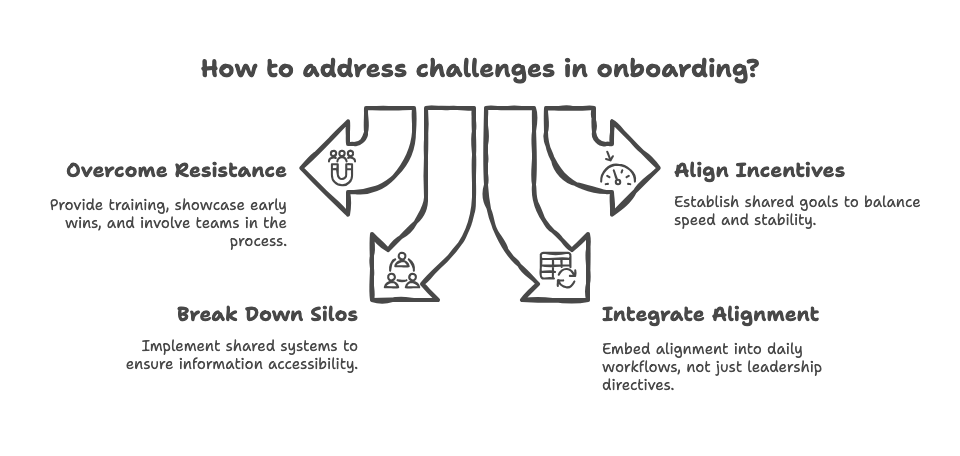
Customer onboarding is your first real opportunity to deliver on the promise your sales team made. When it goes well, customers reach value quickly, trust deepens, and retention becomes the natural outcome. When it goes poorly, even the best product can’t save the relationship. Most onboarding failures aren’t random — they trace back to a small set of recurring problems that Customer Success Managers encounter again and again.
This guide breaks down the five most common customer onboarding challenges and gives you practical, actionable ways to solve each one — whether you’re managing your first account or leading a CS team of twenty.
Why Onboarding Challenges Matter More Than You Think
Research consistently shows that customers who don’t achieve a meaningful outcome within their first 90 days are significantly more likely to churn at renewal. Onboarding isn’t just a welcome phase — it’s a retention lever. Every friction point during onboarding increases the likelihood that a customer will disengage before they’ve truly committed to your product.
The good news: most onboarding problems are predictable. That means they’re also preventable with the right preparation and processes in place.
Challenge 1: Misaligned Expectations Between Sales and the Customer
This is the most common — and most damaging — onboarding challenge. A customer arrives at kickoff expecting capabilities the product doesn’t have, timelines that aren’t realistic, or an outcome that was implied but never confirmed in writing. The result is immediate distrust that’s very hard to recover from.
How to solve it: The fix starts before onboarding begins. Require a structured sales-to-CS handoff that documents what was promised, what the customer’s primary goals are, and what success looks like at 30, 60, and 90 days. During the kickoff call, reconfirm these goals openly and correct any misalignments early. A brief written success plan shared with the customer in the first week creates a shared reference point that prevents disagreements later.
Challenge 2: No Clear Onboarding Milestones or Timeline
When onboarding lacks structure, both the CSM and the customer drift. Without defined milestones, it’s impossible to know whether onboarding is on track — and customers often don’t know what to do next, which leads to low engagement and slow adoption.
How to solve it: Build a milestone-based onboarding plan before the kickoff call. Map out the key actions the customer needs to complete in each phase, assign owners, and attach target dates. A well-structured onboarding checklist gives customers a clear picture of where they are in the journey and what comes next. Share this plan in the kickoff and review progress in every check-in.
Challenge 3: Overwhelming the Customer With Too Much Information
It’s tempting to show customers everything your product can do as quickly as possible. But information overload is one of the most reliable ways to kill engagement. When customers feel overwhelmed, they shut down — logging in less, skipping training sessions, and gradually disengaging.
How to solve it: Use a phased approach. In the first two weeks, focus only on the features that deliver the customer’s primary use case. Resist the urge to demo advanced functionality until the basics are solid. Think of onboarding like learning to drive — you master the steering wheel before you touch the parallel parking. Tailor the depth of training to the customer’s technical ability and role, and let their pace guide yours.
Challenge 4: Weak Internal Alignment Across Teams
Onboarding rarely sits with one team. Sales, CS, product, and support all touch the customer during this phase. When those teams aren’t aligned — on the customer’s goals, their technical setup, their key contacts — the customer experiences inconsistency. They repeat themselves in every call. They receive conflicting information. They feel like nobody is actually managing their account.
How to solve it: Centralise the customer’s onboarding information in your CRM or CS platform so every team member can see the same picture. Run a brief internal sync after the sales handoff to align CS, support, and any technical teams on what this customer needs. Assign a single named CSM as the customer’s primary point of contact and make that clear to the customer from day one.
Challenge 5: Poor Communication Cadence After Kickoff
The kickoff call goes well — and then nothing. The customer doesn’t hear from the CSM for two weeks. By the time the next check-in happens, they’ve lost momentum, forgotten what they were supposed to do, and started to wonder if anyone is paying attention. This is especially common when CSMs carry large account loads.
How to solve it: Set a clear communication cadence at kickoff and stick to it. For most customers, weekly or fortnightly touchpoints in the first 60 days are appropriate. Use a mix of formats — a quick email after each call summarising next steps, a video check-in for complex milestones, and async updates for simpler progress tracking. The goal is to make the customer feel supported without creating meeting fatigue.
Understanding how to set customer expectations clearly from the start makes every subsequent communication easier and more effective.
How to Build an Onboarding Process That Prevents These Problems
Solving individual challenges is useful, but the real goal is to build a repeatable onboarding process that prevents most of them from arising in the first place. Here’s what that looks like in practice:
- Standardise your kickoff template: Every customer gets the same structured first call — goals confirmed, milestones agreed, CSM introduced, communication cadence set.
- Use a shared success plan: A one-page document co-created with the customer that defines what success looks like, key milestones, and who is responsible for what.
- Track onboarding health in your CRM: Flag accounts where milestones are slipping so you can intervene early rather than reactively.
- Run a post-onboarding review: At the end of the onboarding period, ask the customer what worked and what didn’t. Use this feedback to continuously improve your process.
A strong onboarding process is the foundation of everything that follows in the customer lifecycle. For a detailed walkthrough of how to structure each phase, see our guide to the step-by-step customer onboarding process.
The Bottom Line
Most customer onboarding challenges come down to the same root causes: unclear expectations, missing structure, information overload, siloed teams, and inconsistent follow-through. None of these are inevitable. With the right preparation, a clear milestone plan, and a consistent communication rhythm, you can turn onboarding from your biggest retention risk into your strongest competitive advantage.
Start by identifying which of these five challenges shows up most often in your accounts — then build the fix into your process before the next kickoff call.


Leave a Reply