
A few weeks ago, a CSM posted a question in r/CustomerSuccess that quietly went around the profession: do things ever slip through before your weekly check-ins? The setup was simple. Reminders in place. Tasks logged. Weekly summaries running. And yet — occasionally — something gets mentioned in Slack, doesn’t get acted on, and resurfaces later in a client call. Stressful when it happens. Not catastrophic. But the kind of small failure that erodes confidence over time.
The thread itself was short — a handful of replies, a few people nodding along, one comment that landed harder than the rest: that customer messages need to be treated as inputs to triage, not as conversation. The point being that weekly check-ins are too late to be the catch-net. By the time they fire, the thing that should have been actioned has already been buried under three days of newer Slack noise.
The question deserves a longer answer than the thread gave it. Action items slipping between check-ins is rarely about discipline — it’s about system design. This article walks through where the misses actually happen, what “good” looks like, and the minimum viable version of a capture-and-triage system you can build this week without buying new tooling.
Where action items actually go dark
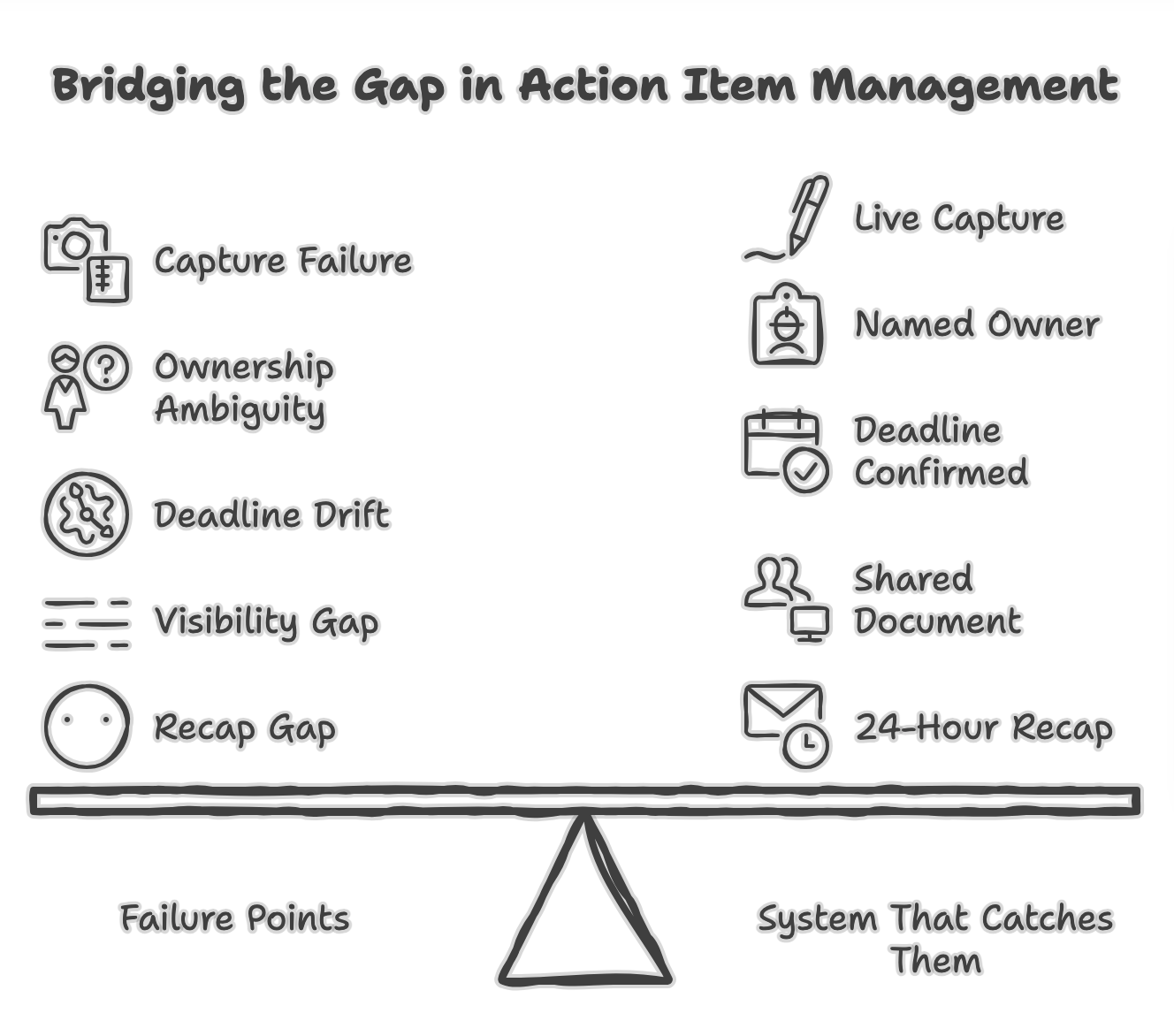
Things don’t slip in one place. They slip in four — and identifying which failure point is hitting your team is the first step to fixing the right problem.
1. The Slack-to-task handoff
This is the most common failure point. A customer sends a Slack message: “Hey, can your team look into the integration timing? It’s been off all week.” The CSM reads it, mentally registers it, replies acknowledging it — and then never converts that mention into a tracked task. There is no system that turns “thing said in chat” into “thing on a list with an owner and a deadline.”
The mention sits in the channel. The CSM moves to the next conversation. By the end of the day, the integration timing question is buried under twenty other messages. The task lives only in the CSM’s working memory, which has the recall reliability of a colander.
2. The triage gap
In real time, every customer signal looks roughly equally urgent. The Slack message about integration timing reads as similar in tone to the email asking for a feature comparison and the support ticket flagging a UI bug. Without a deliberate triage step — explicitly classifying signals as act now / act this week / monitor / archive — the CSM defaults to whichever item was loudest in the last ten minutes.
That default is a recipe for misses. The polite request from a quiet customer gets crowded out by the noisy escalation from a less important account. Triage is the discipline of separating signal volume from signal importance, and most CS teams don’t do it deliberately enough.
3. Cognitive load
The typical mid-market CSM carries 40 to 80 accounts. Each account has multiple stakeholders. Each stakeholder generates Slack messages, emails, support tickets, and conversation notes from calls. The math is brutal: at 60 accounts with three active stakeholders each, that is 180 ongoing relationship threads competing for working memory.
No human brain holds 180 threads reliably. The ones that get acted on are the ones that surfaced most recently, or that came from the noisiest stakeholder, or that triggered an emotional response. The rest fade. A capture system isn’t a productivity nice-to-have at this scale — it is the only way the role functions.
4. Weekly cadence as the catch-net
Most CS teams use weekly check-ins or weekly summaries as the safety net for action items. The logic feels reasonable: if anything slipped during the week, the Friday sweep will catch it. In practice, this is too slow. By Friday, a Tuesday Slack mention has aged 72 hours — long enough for the customer to notice the silence, escalate to their account exec, or simply lose confidence in the responsiveness of their CS partner.
Weekly cadences are the right rhythm for strategic review. They are the wrong rhythm for catching dropped balls. The catch-net needs to run daily, not weekly — and it needs to run on inputs that have been captured the moment they arrived, not retrospectively reconstructed three days later.
What “good” actually looks like: a capture-and-triage system
The teams that consistently catch action items before they slip have built four things into their workflow. None of them require new tooling — the existing Slack, CRM, and task-management stack already covers the requirements. What changes is the operating discipline.
Inputs: every signal channel feeds one queue
Define every channel where customer signals can arrive: Slack mentions, support tickets, customer emails, call notes, in-product feedback, executive pings. List them. There should be no more than six or seven for most teams.
Then commit to a single capture surface — one place where signals from any of those channels get logged. It might be a Notion page, a CRM-native task list, an Asana project, or a Trello board. The specific tool matters less than the rule: if a customer signal exists, it lives in the queue within 24 hours. No exceptions for “I’ll remember this one” or “this seems too small to log.”
Capture rule: said equals logged
The single most important rule in the system is this: if a customer says it, it gets logged. The capture happens within minutes of the signal arriving, not at the end of the day, not at the weekly review. The cost of logging a signal that turns out to be unimportant is 30 seconds. The cost of failing to log one that turns out to matter is a follow-up email from the customer’s CFO three weeks later asking why nobody got back to them.
This discipline is one of the habits experienced CSMs build early. Newer practitioners often resist it because logging feels like overhead. A year in, they understand it isn’t overhead — it is the only way the job stays manageable as the book grows.
Triage rhythm: daily 15-minute sweep
Every captured signal needs to be triaged within 24 hours. The daily sweep is short — 15 minutes is enough — and runs through one question per item: does this need to be acted on this week, watched, or archived? Items in the “act this week” bucket get an owner and a target completion day before they leave the queue.
The 15-minute daily sweep is the single highest-leverage habit a CSM can build. It is what separates proactive customer management from the reactive scramble most CS teams settle into. It runs at the same time every day — typically the first 15 minutes of the morning — and it is non-negotiable. Skip it for a week and the queue becomes unmanageable; skip it for a month and the system has effectively been abandoned.
Routing: every item leaves the queue with an owner, a deadline, and a status
The triage step doesn’t end with classification. Every item that survives triage gets three things attached to it before it leaves the queue: an owner (the specific person responsible), a deadline (the day by which it should be done or escalated), and a visible status (so anyone looking at the queue can see whether it’s blocked, in progress, or waiting on the customer).
Without these three fields, items rot. With them, the queue becomes a living document of the team’s customer commitments — visible to leadership, useful for handoffs when someone is on holiday, and self-correcting because misses become obvious within days rather than weeks.
The honest part: why most CSMs don’t have this system
It would be easy to read the section above and conclude that any CSM who is dropping action items just needs to be more disciplined. That conclusion would be wrong, and it would miss the structural reality that the original Reddit post quietly hinted at and one of the commenters named directly: most CSMs are not failing because of insufficient personal discipline. They are failing because the role itself has been built in a way that makes the four problems above inevitable.
Three structural issues stand out:
Books of business that are too large. A CSM with 80 accounts cannot run the daily 15-minute sweep across all of them — that’s 80 customers’ worth of signals to process in 15 minutes, which is impossible in any meaningful sense. The system breaks not because the CSM is undisciplined, but because the math doesn’t work. The fix isn’t a better task tool; it is a smaller book or a tiered service model.
Internal busywork that crowds out customer work. Many CS teams spend 30 to 50 percent of their day on internal reporting, status updates, and meetings that have nothing to do with the customer. A CSM who has to spend 90 minutes writing a Monday status report has 90 minutes less to spend on the daily triage sweep. The structural failure isn’t the CSM’s fault — it is a leadership choice about how the team’s time is allocated.
Tooling sprawl that fragments the queue. If customer signals live in Slack, in the CRM, in the support tool, in three different inboxes, and in a fourth project management tool, there is no single queue to triage. The capture rule — said equals logged, in one place — is impossible to enforce when the team has six places signals could be logged. Consolidating tooling is unglamorous work, but it is what makes the rest of the system possible.
Naming these issues directly matters because it relieves the CSM of the unfair burden of treating every dropped action item as a personal failing. The structural overload most CS roles carry is real, and pretending otherwise produces guilt rather than improvement. The honest framing: build the system you can build inside the constraints you have, and escalate the structural problems to leadership with the same rigour you bring to customer commitments.
The minimum viable version you can build this week
If the full capture-and-triage system feels like a heavy lift, here is the minimum viable version. It can be built in an afternoon, run with no new tools, and start catching missed action items by the end of the first week.
Day one. Pick one capture surface. Could be a single Notion page, a single CRM task list, a single shared spreadsheet. The rule is one place, not the best place. Title it something obvious like “CS Triage Queue” and pin it where you can find it from any device.
Day one through three. Every time a customer signal arrives in any channel, log it in the queue within 30 minutes. Three fields: customer name, what was said, where it came from (Slack / email / call / ticket). Don’t try to triage yet. Just capture.
Day two onwards. Add a 15-minute daily sweep at the start of each morning. Triage every new item from the previous 24 hours: act this week / monitor / archive. For everything in “act this week,” add an owner and a target day. The sweep ends when every item has been classified.
Day five. Run the first weekly review. The point isn’t to catch misses — the daily sweep does that. The weekly review is for spotting patterns: which accounts are generating the most signals, which signal types most often need escalation, which items have been stuck in “act this week” for too long. Pattern recognition at the weekly cadence is the right use of weekly time.
Run this for six weeks. By then the discipline will have moved from effortful to automatic, and the volume of “things that came up later in a client call” will have dropped meaningfully. This is the same rhythm that powers the broader set of ten retention practices experienced CSMs run consistently — capture, triage, act, review.
Common questions about catching action items
What’s the difference between a check-in cadence and a triage cadence?
A check-in cadence is the rhythm of structured conversations with the customer — weekly, bi-weekly, or monthly meetings, QBRs, renewal reviews. A triage cadence is the internal rhythm of processing signals that have come from the customer between those check-ins. The two are not substitutes for each other. Check-ins handle strategic alignment; triage handles the day-to-day stream of action items. Most CS teams have the first and lack the second, which is precisely why things slip.
Should every Slack message become a task?
No — only every Slack message that contains a customer signal that might require action. “Thanks for the update” doesn’t get logged. “Hey, can your team look into the integration timing?” does. The judgement call is: is there an implicit or explicit ask buried in this message? If yes, log it; the triage step decides whether to act on it. If no, move on. After a few weeks, this filter becomes near-automatic.
How do you handle action items from informal conversations?
Informal conversations — a comment dropped at the end of a call, a hallway chat at a customer site, a brief mention on a Zoom that wasn’t recorded — are where the highest percentage of action items get lost. The fix is the same as for written channels: capture within 30 minutes. A voice memo on the way back from the meeting, a quick note typed into the queue before the next call starts, a one-line email to yourself. The capture happens before the next interruption, or it doesn’t happen.
Is AI actually solving this yet?
AI tooling is improving meaningfully — transcription tools that extract action items from call recordings, Slack-to-task automations that log mentions to a queue, summarisation tools that surface the items in a thread that look like commitments. These are real productivity gains. But none of them replace the structural problem: AI helps with capture, not with triage. A CSM with 80 accounts and an AI that auto-logs every Slack mention now has a much longer queue, not a more manageable one. AI is a multiplier on a working system. It is not a substitute for one.
The system is the discipline
The CSM who posted that Reddit question wasn’t asking because they had a discipline problem. They were asking because they suspected the problem was structural — and they were right. Action items slipping between weekly check-ins is what happens when a role with 60 accounts and six signal channels relies on memory and a Friday review to catch everything. The math doesn’t work. The fix is not more willpower. The fix is a system that runs daily, captures everything, triages on a 24-hour cadence, and routes every survivor with an owner, a deadline, and a visible status.
The same logic underpins the broader work of CS — it shows up in the way the recap discipline that holds the next conversation together after a tough call works, in the Customer Success metrics worth tracking, and in the early-warning signals that surface 90 days before churn. The pattern is consistent: the teams that catch the small things consistently are the ones that build systems for catching them, then run those systems with religious daily discipline. Everyone else relies on memory and is surprised, occasionally, when memory fails.
Build the system once. Run it daily. Stop relying on Friday to catch what Tuesday should have caught.

Leave a Reply