
Most customers who churn don’t slam the door on the way out. They drift. Login frequency tapers off. The product champion changes jobs. The renewal questionnaire gets opened twice and never finished. By the time the cancellation email arrives, the decision was made weeks earlier — quietly, in a meeting your team wasn’t invited to.
That quiet drift is the reason customer churn has become arguably the most consequential metric in B2B SaaS. Acquisition gets the marketing budget, the sales team, the dashboards on the office wall. Churn gets a quarterly review and a polite note in the board deck. The asymmetry is upside down, because the math of churn — once you understand how it compounds — is what determines whether your business grows or stalls.
This guide covers what customer churn actually is, the four types that matter, the formulas to calculate each one correctly, and why churn deserves significantly more attention than most CS leaders give it.
What customer churn actually is
At its simplest, customer churn is the rate at which customers stop doing business with you over a defined period. In subscription businesses, that means cancelling, failing to renew, or downgrading to a tier below the one they were on. It is the structural counterweight to acquisition — every customer your sales team brings in is, eventually, a customer your Customer Success function will need to keep.
The terminology gets messy because “churn” is used to describe two related but distinct things. Customer churn (sometimes called logo churn) measures the number of accounts you lose. Revenue churn measures the dollar value of what you lose. Tracking only one tells you a partial story — usually the more flattering one.
The distinction matters more than most teams realise. Lose ten SMB customers paying $99 a month each, and your customer churn rate looks bad but your revenue churn looks manageable. Lose one enterprise customer paying $50,000 a year, and your customer churn rate barely moves while your revenue takes a real hit. Sophisticated CS teams track both metrics and segment them by customer cohort. The combination is what lets you tell the difference between “we have a product-market-fit problem in a specific segment” and “we lost our biggest account because of one specific issue.”
The four types of churn that matter
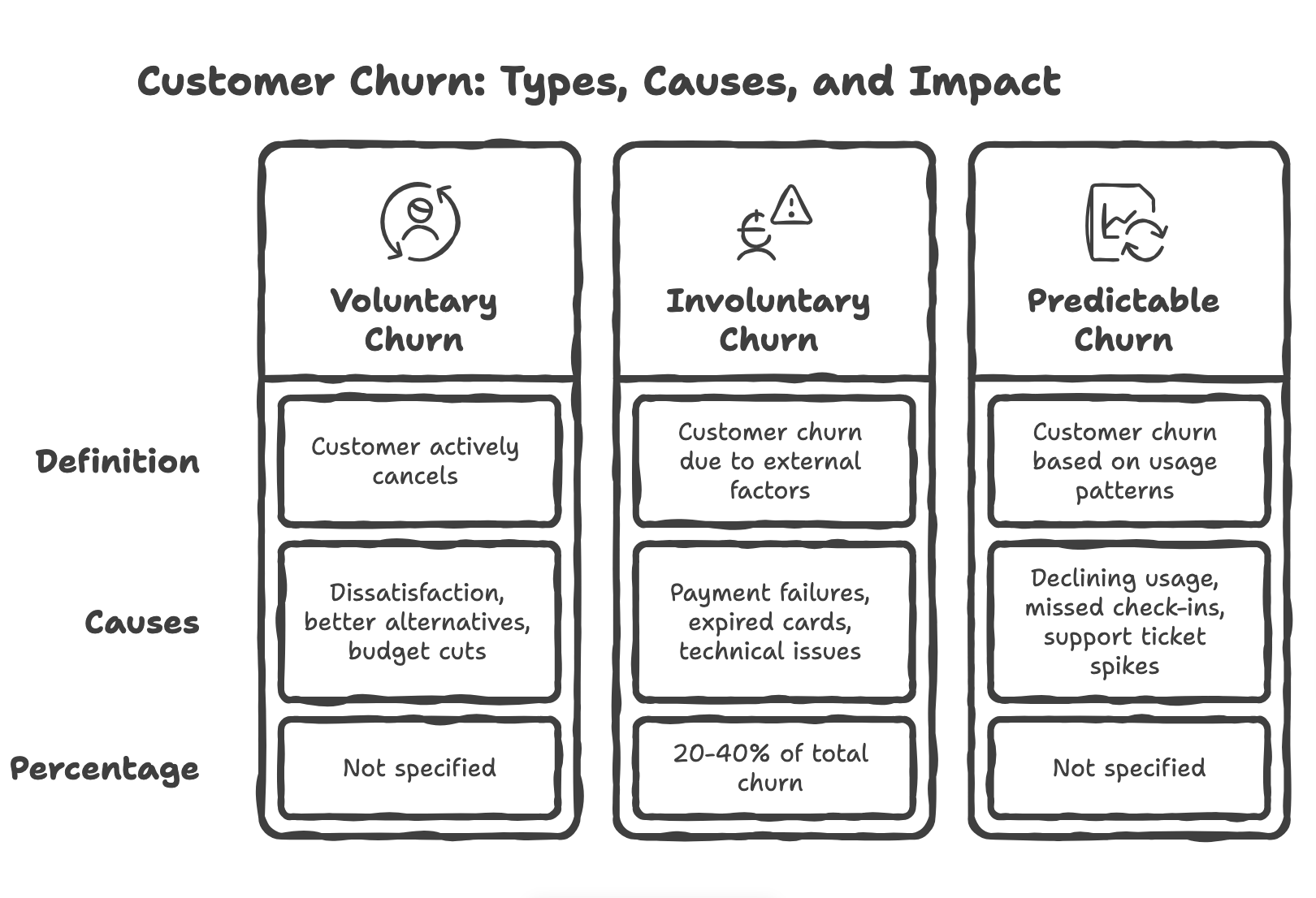
Once you accept that churn isn’t a single number, you need a clear taxonomy. Four types are worth tracking specifically — they answer different questions and respond to different interventions.
1. Voluntary churn
Voluntary churn is the customer who actively chose to leave. They hit the cancel button, didn’t renew when prompted, or wrote the email that ends “we’ve decided to discontinue our subscription.” This is the type CS teams traditionally think about — and it usually points to one of three causes: insufficient value realisation, a better competitor, or a bad onboarding experience that the relationship never recovered from.
According to Churnkey’s State of Retention 2025 report, voluntary churn averages around 7% monthly across the SaaS businesses they tracked. That number varies enormously by segment, but it is the largest component of total churn for most B2B SaaS companies.
2. Involuntary churn
Involuntary churn is the customer who didn’t mean to leave. Their credit card expired. The bank declined the payment. The billing email went to a former employee’s inbox. The dunning emails got filtered to spam. By the time anyone notices, service has been suspended and the relationship has lapsed by accident.
This category is more significant than most CS leaders think. Recurly’s 2025 benchmarks suggest involuntary churn accounts for 20% to 40% of total SaaS churn, and B2B SaaS companies experience payment decline rates of 8% to 10% on average. The encouraging news is that involuntary churn is also the most fixable: smart payment retry logic, automated card updaters, and dunning workflows can recover a substantial share of these failures without any direct CS intervention. Recurly’s data suggests fixing involuntary churn alone can lift revenue by approximately 9% in the first year of investment — making it one of the highest-ROI retention investments available to most SaaS businesses.
3. Gross revenue churn
Gross revenue churn is the dollar value lost when customers cancel or downgrade — before any expansion revenue is added back in. It is the unflattering view: pure attrition, no offsetting wins.
Tracking gross revenue churn matters because it tells you what your retention engine is actually doing without expansion masking the picture. A company with 110% net revenue retention can still have a 15% gross revenue churn rate — meaning the existing customer base is shrinking by 15% a year, but a smaller group of expanding customers is more than making up for it. That’s a perfectly viable business model in some segments, but it requires you to see both numbers honestly rather than lean on the prettier one in board reviews.
4. Net revenue churn (and its inverse, NRR)
Net revenue churn is gross revenue churn minus expansion revenue from existing customers. When expansion exceeds churn, net revenue churn turns negative — meaning your existing customer base is generating more revenue this period than it was last period, even before any new customers arrive.
The more common framing of this metric is its inverse: Net Revenue Retention (NRR). NRR above 100% means your existing customers are growing the business on their own. According to data published by Optifai’s Pipeline Study and ChartMogul’s benchmark of over 2,100 companies, the median B2B SaaS NRR sits around 106%, with best-in-class companies exceeding 130%. Companies with NRR above 106% reportedly grow about 2.5 times faster than those below the threshold — a gap that explains why NRR has become the headline metric in most SaaS investor decks.
How to calculate churn correctly
Three formulas every CS leader should know — and the most common mistakes that produce misleading numbers.
1. Customer churn rate
The basic formula is straightforward:
Customer churn rate = (Customers lost during the period ÷ Customers at the start of the period) × 100
Worked example: a SaaS company starts the month with 1,000 customers. Over the month, 30 cancel. The customer churn rate for that month is 30 ÷ 1,000 × 100 = 3%.
The most common mistake here is using end-of-period customer count as the denominator instead of start-of-period count. Doing so deflates the rate. Always anchor to the start of the period.
The second common mistake is multiplying monthly churn by 12 to estimate annual churn. That’s not how compounding works. A 5% monthly churn rate produces a 46% annual churn rate, not 60%, because each month you’re losing a percentage of an already-shrunk base. The correct conversion is:
Annual churn = 1 − (1 − monthly churn rate)^12
2. Gross revenue churn rate
For revenue churn, the formula substitutes recurring revenue for customer counts:
Gross revenue churn rate = (MRR lost during the period ÷ MRR at the start of the period) × 100
Worked example: a company starts the month with $500,000 in MRR. Over the month, $25,000 of that MRR cancels or downgrades. Gross revenue churn rate is $25,000 ÷ $500,000 × 100 = 5%.
Notice this formula deliberately excludes any expansion revenue. That separation is the point: gross revenue churn isolates the attrition signal so you can see it clearly, undiluted by upsell wins that might be happening elsewhere in the book.
3. Net revenue retention (NRR)
NRR pulls expansion revenue in alongside churn:
NRR = ((Starting MRR + Expansion MRR − Contraction MRR − Churned MRR) ÷ Starting MRR) × 100
Worked example: $500,000 starting MRR + $40,000 in expansion (upgrades, additional seats) − $10,000 in contraction (downgrades) − $25,000 in churn = $505,000 ending MRR from the existing base. NRR = $505,000 ÷ $500,000 × 100 = 101%.
That 101% means the existing customer base is now worth slightly more than it was a month ago, despite losing 5% of MRR to outright churn. The expansion engine is doing the work — a small surplus today, but one that compounds significantly over a year if maintained.
For a fuller view of the metrics worth tracking alongside churn, see our guide to Customer Success metrics every team should monitor.
Why churn matters more than most CS leaders treat it
The case for paying significantly more attention to churn than most teams currently do rests on three observations — none of which are theoretical.
First, the math compounds. A 5% monthly churn rate doesn’t sound dire until you run it forward: 46% of the customer base gone in a year. At 10% monthly, that figure rises to over 70%. At 3% monthly — closer to the B2B SaaS average — it’s still 31% annually. The acquisition team has to replace every one of those customers just to keep revenue flat. That is a treadmill, not a flywheel.
Second, the acquisition-cost asymmetry is significant. Research widely cited from Harvard Business Review puts the cost of acquiring a new customer at approximately five times the cost of retaining an existing one, with some industries showing ratios as high as 25 times. Bain & Company research suggests that a 5% increase in customer retention rates can produce profit increases of 25% to 95%. The probability of selling to an existing customer sits at 60% to 70% according to data from the Marketing Metrics literature; for a new prospect, it drops to 5% to 20%.
The implication is straightforward: every dollar invested in retention has a higher expected return than the same dollar invested in acquisition, particularly past the early-stage product-market-fit phase. Yet most B2B companies still allocate the majority of their growth budget to the acquisition side of the ledger.
Third, expansion revenue from existing customers is now the primary growth engine. Recent benchmarks suggest existing customers generate around 40% of new ARR across B2B SaaS, and over 50% for companies above $50 million in ARR. Retention isn’t just defensive any more — it is where the upside lives. The companies that win in 2026 are the ones running an engine that compounds through retention and expansion, not the ones obsessing over fresh logos while the back door stays open.
Strong churn discipline isn’t about preventing every cancellation. It is about understanding the patterns early enough to intervene where intervention is possible, and accepting churn where it isn’t. For the practical playbook on building that discipline, see our guide to customer retention strategies and the ten practices that protect retention experienced CSMs use day to day. The habits experienced CSMs build early overlap heavily with the ones that keep churn in check.
Common questions about customer churn
What is a good customer churn rate?
There is no single answer, but directional benchmarks for B2B SaaS in 2026: under 5% annual churn for mid-market and enterprise products, and 5% to 7% annual churn for SMB-focused products. Monthly equivalents are roughly under 1% for enterprise and under 2% for SMB. EdTech and budget consumer SaaS products structurally see higher rates — sometimes 8% to 10% annually — because the underlying customer base is more volatile. Compare yourself to companies serving the same customer segment, not to the SaaS market as a whole.
Is churn the same as attrition?
In subscription businesses, the terms are largely interchangeable. “Churn” tends to be used in SaaS and digital subscriptions; “attrition” is the older term used in telco, financial services, and other long-running subscription industries. Both describe the same phenomenon: customers leaving over a defined period. The mathematical formulas are identical.
Should I track monthly or annual churn?
Both, for different purposes. Monthly churn is the operational metric — it shows whether interventions are working week by week and surfaces problems while there is still time to act. Annual churn is the strategic metric — it captures the full cycle of contract renewals and shows the true health of the relationship over time. Reporting only one to leadership produces an incomplete picture. The most useful framing is monthly churn for the CS team’s own dashboards and annual churn for board-level review.
Can churn ever be a good thing?
Yes — when the customers you’re losing weren’t a good fit in the first place. If a customer was acquired through aggressive top-of-funnel tactics, never reached value realisation, and is consuming more support resources than they are generating in revenue, their churn improves your unit economics. The mistake is celebrating that outcome generally rather than learning from it. Track who churns and why; if a clear pattern emerges (industry, company size, use case), that’s a signal to refine your ICP rather than fix retention.
The discipline that holds the business together
The teams that consistently keep churn under control don’t have a single magic intervention. They have a discipline: measure honestly across all four types, segment ruthlessly so they can see where the problem actually lives, and act on early signals — usage decline, missed milestones, stakeholder turnover — well before the cancellation conversation begins.
Focus Digital’s 2025 research found that voluntary churn accelerates roughly 90 days before cancellation, with product usage declining by an average of 41% in the quarter preceding the decision. That window is the single most actionable insight in the entire churn literature: the data is already there, in your usage logs, telling you which accounts need attention months before the renewal conversation. Whether your team acts on it is what separates strong CS practice from reactive CS practice. For the broader framing on which this rests, see the strategic case for Customer Success and our overview of how a proactive customer management approach outperforms reactive work.
Customer churn is the metric that quietly determines whether everything else you’re doing in CS adds up to a growing business or a treadmill. Treat it accordingly — measure all four types, calculate them honestly, and act early when the signals fire. The compounding works in both directions; the side it is working for you on depends almost entirely on the discipline you bring to the metric.


Leave a Reply