
A post in r/CustomerSuccess earlier this month named a problem that quietly eats every CS team above a certain size: nobody actually knows how the customer process works end to end. The author described knowledge scattered across five places — a bit in Salesforce, a bit in Jira, a bit in support tickets, a bit in Slack, and a bit in the heads of people who have been around the longest. A simple question like “why does this escalation always bounce between teams?” becomes a 30-minute archaeology project across five tools. The map of the customer journey looks clean on paper. In practice, no single person can hold the whole thing in their head, and no single system holds it either.
The comment that hit hardest came from a CSM who described an escalation last month — a customer asking why their renewal pricing was different from what they had been told at onboarding. The CSM needed answers from sales, from the original CSM who had since left, from billing, and from a Slack thread that may or may not have still existed. It took three hours to reconstruct what should have been a five-minute lookup. Her observation about why this keeps happening: everyone thinks their piece of the process is documented. Sales thinks they handed off properly. Support thinks the ticket history is clear. Product thinks the release notes cover it. Nobody owns the end-to-end picture.
This article is about that gap. Why it shows up, what it actually costs, and the operating discipline that keeps the map usable once the team is large enough that no single person can hold it.
Why the map breaks above 30 to 40 people
One of the most useful observations in the thread came from a CSM who had watched this happen at two companies: the knowledge fragmentation problem barely exists at 20 people, becomes noticeable around 30 to 40, and is fully entrenched by 100. The threshold isn’t arbitrary. It is the point at which three things converge.
The number of handoffs exceeds the number of relationships a person can hold. At 15 people, the CSM knows the sales rep, the support lead, and the product manager personally. Questions get answered with a Slack DM. At 60 people, the CSM has never spoken to the person who closed the original deal, the support engineer who handled the integration bug six months ago, or the PM who shipped the feature the customer is asking about. The personal-network shortcut that worked at small scale stops working, and the team falls back on whatever was written down — which is usually nothing complete.
Tool sprawl outpaces documentation discipline. A 20-person company uses three tools and a shared drive. A 60-person company uses Salesforce, Jira, Zendesk, Slack, Notion, Confluence, two analytics platforms, and a CS-specific tool that someone bought last year and only half the team uses. Each tool has its own conventions, its own owners, and its own decay rate. The fragmentation isn’t a failure of any single team. It is a structural consequence of growing fast in a category where every function has its own software.
Turnover starts erasing the oral tradition. The first CSM leaves. The original implementation lead moves to a different company. The sales rep who knew why the contract was structured the way it was takes a job elsewhere. Each departure removes a layer of context that was never written down, because at the time everyone assumed it would always be obvious. The institutional memory that papered over the documentation gaps quietly disappears, and the gaps become visible.
One comment in the thread captured the failure mode plainly: companies have huge critical processes that are completely undocumented because the one person who built them quietly left three years ago, and now everyone is afraid to touch anything because one wrong move could break things in ways nobody can diagnose. That fear is rational. The cost of it, however, compounds across every quarter the problem goes unaddressed.
Where customer process knowledge actually lives
The first step in fixing this problem is being honest about where the knowledge actually sits. Four categories, in roughly descending order of formality.
1. CRM and ticketing systems
Salesforce, HubSpot, Zendesk, Jira. This is the most structured of the four sources — fields, statuses, ownership, audit trails. The strength is that the data is queryable and time-stamped. The weakness is that what lives in these systems is the formal record, not the reason. You can see that the contract was renewed at a different price. You cannot see the conversation that led to the different price, the verbal commitment made on the call, or the executive escalation that drove the negotiation. The CRM tells you what happened. It rarely tells you why.
2. Internal communication tools
Slack, Microsoft Teams, email threads. This is where the reason lives. The decision to extend a discount, the agreement to push back a deadline, the offhand comment from a product manager confirming that a feature would ship by Q3 — all of it happens here. The problem is that this material decays fast. Slack history is technically searchable, but the conversational context that made the message meaningful is rarely preserved. Three months later, a search returns a fragment that nobody can interpret without the surrounding thread, which has scrolled into the archive.
3. Wikis and shared documents
Notion, Confluence, Google Drive, internal knowledge bases. This is the layer most companies invest in when they decide to “fix” their documentation problem. It usually works for about six months. After that, the documents drift out of date, the original authors stop updating them, and new hires can’t tell which pages are current and which were written for a workflow that changed eighteen months ago. One CSM in the thread named the real problem precisely: the hard part isn’t surfacing old artifacts, it is knowing which ones are still true.
4. Tribal memory
The people who have been around the longest. The CSM who has worked with this particular customer segment for three years. The sales engineer who designed the integration when it was first built. The support lead who remembers the workaround for the bug that gets reported every quarter. This is the most accurate of the four sources, because it includes the reasons, the workarounds, and the edge cases. It is also the most fragile, because it lives in a single human’s working memory and disappears with two weeks’ notice on a Friday afternoon.
The hidden cost
The CSM in the thread who spent three hours reconstructing a renewal-pricing question wasn’t an outlier. She was a representative data point.
Research published in Bloomfire’s 2025 Value of Enterprise Intelligence report, citing Gartner, found that knowledge workers spend on average 10 percent of their working week searching for information they need to do their jobs. For a CSM on a 40-hour week, that is four hours weekly — a half-day every week, spent not on customer relationships, not on retention work, not on expansion conversations, but on archaeology. Across a CS team of 12 people, that is roughly 250 hours a month of senior, expensive, customer-facing capacity going into hunting for context that should have been retrievable.
The 2025 Panopto knowledge-management research — widely cited in industry reporting — estimated that inefficient knowledge sharing costs large U.S. businesses an average of $47 million annually in lost productivity, with IDC putting the Fortune 500 total at $31.5 billion a year. Those numbers are not specific to CS, but the underlying mechanic — institutional knowledge trapped in the wrong places, eroding the productivity of every team that depends on it — is exactly what the Reddit thread was describing.
The cost shows up in CS-specific ways too. According to 2025 onboarding benchmarks compiled by Docustream and others, the median time-to-productivity for client-facing roles in B2B sits at five to six months — substantially longer than the 65-day median for general knowledge work. A meaningful share of that ramp time is spent learning the same scattered process knowledge that already-trained CSMs are still hunting for. Every new hire is essentially re-discovering what the team already knew but couldn’t write down.
And these are just the visible costs. The invisible ones are larger: the renewal that quietly slipped because nobody surfaced the implementation friction from eighteen months ago; the escalation that went sideways because the original commitment was buried in a Slack DM; the expansion conversation that didn’t happen because the CSM didn’t know the customer had been asking about that exact feature in support tickets for six months. None of these show up on a dashboard as a knowledge-fragmentation cost. They show up as missed numbers, attributed to other causes.
What good actually looks like
The teams that handle this well share three operating habits. None of them require new tooling. What changes is the discipline around what already exists.
Pick a primary system of record per artifact type — and enforce it
One CSM in the thread described the practice that turned things around at his company: the support ticket is the record. If a decision got made in Slack, it had to get logged in the ticket. If a conversation happened on a call, the recap landed in the ticket. The rule wasn’t “document everything everywhere” — it was “every artifact type has one home, and that home is the source of truth.” Onboarding milestones live in Salesforce. Technical decisions live in Jira. Customer conversations live in the support tool. Process-level decisions live in Notion. Slack is for transient coordination, not for permanent record.
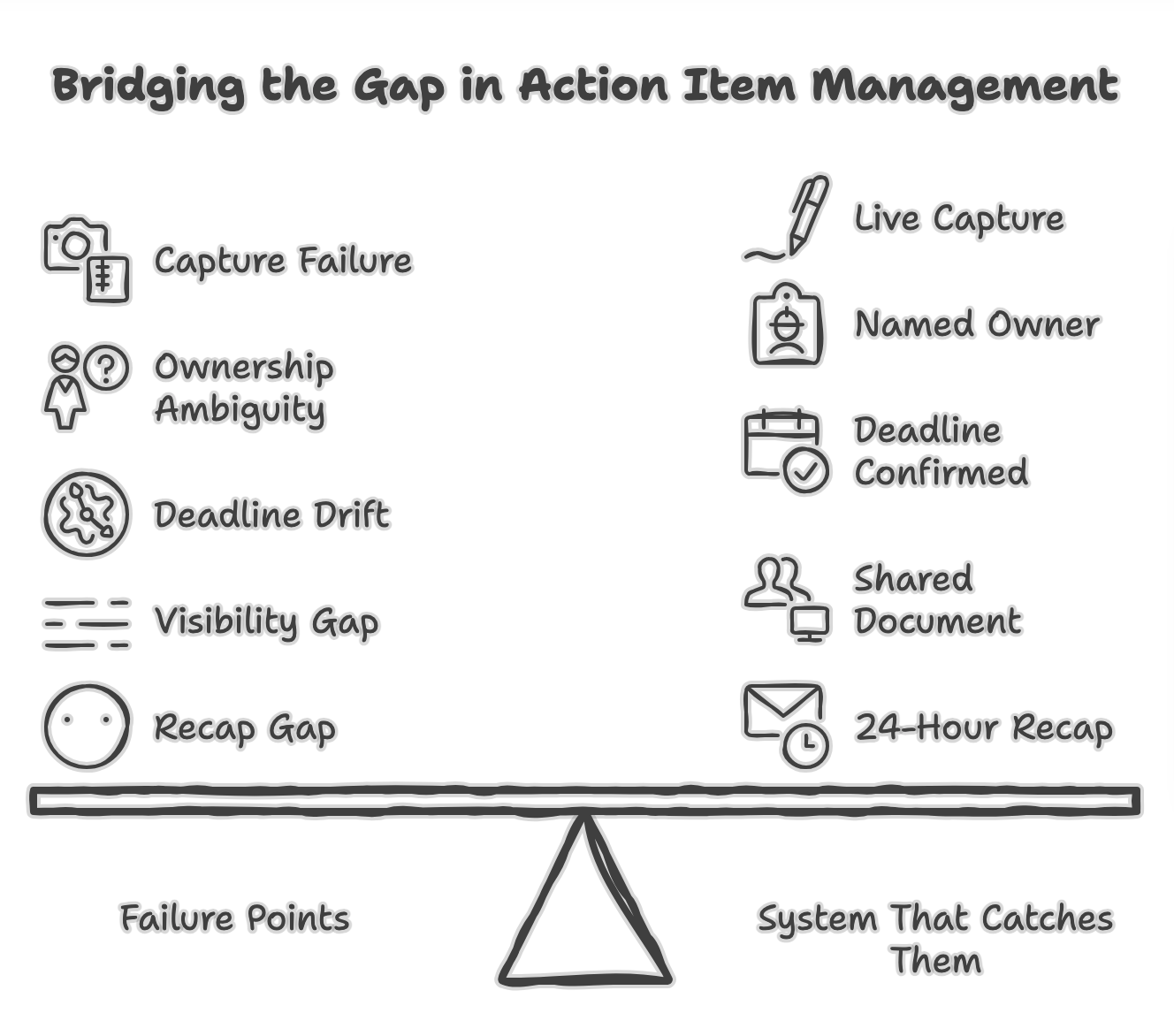
The discipline this requires is small but unforgiving: every important conversation ends with a 60-second write-up to the primary system. The cost is real — maybe 15 minutes a day across a CSM’s portfolio. The payback is the elimination of the three-hour archaeology projects. This is the same operational discipline that underpins our guide to the discipline of capture and triage — the same problem, different timescale.
Run a per-account context layer
The CSM who lost three hours to renewal archaeology had already built a workaround: she keeps a running doc per account that connects the dots across Salesforce, support tickets, and Slack. She described it as ugly but a lifesaver. It is also, frankly, what every senior CSM ends up doing eventually — because the cost of doing it once per account is much lower than the cost of reconstructing context every time a question fires.
The per-account context doc is the human-glue layer. It doesn’t replace the systems of record — it indexes them. For each customer: stakeholders and their context, the original deal structure and any verbal commitments, key historical escalations and how they were resolved, current open threads with links into the relevant tickets and Slack channels, and the renewal narrative. Reviewed and updated weekly, this doc becomes the thing the CSM hands to a colleague during PTO and the thing the new CSM reads on their first day with the account. It is the operational form of documenting patterns rather than problems.
Treat handoffs as the highest-risk moment in the relationship
Most of the fragmentation pain shows up at handoffs — sales to CS, CSM to CSM during transitions, CS to support during escalations. The teams that handle this well build a deliberate handoff protocol with a written artefact at each transition: a structured document the receiving party signs off on before the handoff is considered complete. The handoff between sales and Customer Success in particular is the moment when most of the original deal context lives or dies.
The protocol doesn’t need to be elaborate. A one-page handoff doc covering deal context, customer goals, key stakeholders, commitments made, and known risks. What it does need is to be non-negotiable: no handoff happens without it, and the receiving CSM is expected to have read it before the first introductory call. The discomfort of enforcing the protocol is much smaller than the discomfort of repeatedly inheriting accounts you know nothing about.
Common questions
When does this problem actually start?
The threshold most practitioners describe is somewhere between 30 and 40 people — the point at which the personal-network shortcut stops working. Below that size, the team knows each other well enough that questions can be answered by walking across the room or sending a Slack DM to the one person who would know. Above it, the network is too large to navigate informally, and the gaps in formal documentation start producing visible cost. The problem doesn’t actually start at 30 — it has been accumulating since day one — but that is when it starts to be felt.
Is the answer better documentation or better tooling?
Neither, in isolation. Better tools don’t fix this problem because the failure mode isn’t “information is missing” — it is “information is in the wrong place, or in the right place but stale.” Buying another knowledge management system on top of the seven you already have doesn’t help. Better documentation alone doesn’t fix it because the discipline to keep documentation current is the actual scarce resource, not the documentation itself. The answer is operating discipline: a small number of clear rules about which artefact type lives where, enforced consistently, with someone owning the rot. Tooling supports that discipline; it doesn’t replace it.
What about AI-assisted documentation tools?
This is the most-asked question in CS knowledge management circles right now, and the honest answer is: useful at the edges, not a substitute for the discipline. The current generation of AI tools is genuinely good at indexing scattered artefacts and answering natural-language questions against them. Some teams are experimenting with pipelines that pull Salesforce records, Jira tickets, and Slack archives into a single searchable layer with an AI interface on top. The pattern shows promise. The limitations are also real: AI tools surface what is captured, but they cannot tell you what is still true. A confidently retrieved answer from an eighteen-month-old Slack thread can be more dangerous than no answer at all. The right framing is the same one that applies to AI in operational workflows generally — a multiplier on a working system, not a replacement for owning the process.
What is the minimum viable version a CSM can run alone?
If the broader team isn’t building this discipline, a single CSM can still protect their own accounts. The per-account context doc is the place to start: one page per customer, reviewed and updated weekly during the same Friday block already used for win-logging and pipeline review. Pair it with the rule that every important conversation ends with a 60-second recap to the system of record — the support ticket, the Salesforce account, wherever the team’s primary record lives. This is small enough to build in a week and durable enough to survive the team scaling around you. It also makes the case for broader discipline easier to argue when leadership eventually asks why your accounts are easier to hand off than everyone else’s.
No single system becomes the truth
The most useful reframe to take from the Reddit discussion is the recognition that the search for a single system that will hold all the customer process knowledge is a category error. The knowledge is, and will continue to be, distributed across the tools where work actually happens — Salesforce because that is where deals are tracked, Jira because that is where engineering work happens, Slack because that is where humans coordinate, and people’s heads because that is where judgement lives. The goal isn’t to consolidate. The goal is to build the operating discipline that turns the scattered artefacts into a usable map.
That discipline rests on three things. First, a clear assignment of which artefact type lives in which system, enforced through the practice of writing every important decision into the primary record within minutes of the decision being made. Second, a per-account context layer that indexes across the systems for each customer, owned by the CSM and treated as the document that survives the CSM’s eventual departure. Third, a non-negotiable handoff protocol that produces a written artefact at every transition, so the knowledge doesn’t leak when people move. None of this is glamorous. All of it compounds. The teams that have built it look, from the outside, like they have somehow avoided the chaos that everyone else lives in. From the inside, they have just been doing the unglamorous work that turns scattered artefacts into a map that holds up.
The structural overload that most CS roles carry makes this discipline harder to install — there is no time, and the work is invisible until it isn’t — but it is also the highest-leverage operational investment a CS team can make. For the broader operating model these habits fit inside, see our overviews of the Customer Success function and ten retention practices experienced CSMs build into their workflow. And for the recap-and-document discipline that turns every customer conversation into a durable artefact, see our guide on the recap discipline that creates a paper trail.
The CSM who spent three hours reconstructing a renewal-pricing question already knew what the fix looked like. She had built it for her own accounts. The question was always whether the rest of the team would build it too — and whether leadership would create the conditions that made building it possible. That is the work. It compounds in both directions: the teams that invest in the discipline get easier and easier to scale, and the teams that don’t get harder and harder to operate, until one tenured person takes PTO and the cracks become impossible to ignore.


Leave a Reply