

Retaining customers is dramatically more profitable than acquiring new ones. Research from Bain & Company found that a 5% increase in retention rates can increase profits by 25% to 95%. And according to Harvard Business Review, acquiring a new customer is anywhere from 5 to 25 times more expensive than retaining an existing one. This guide covers the most effective strategies CSMs can use to reduce churn, protect revenue, and grow accounts.
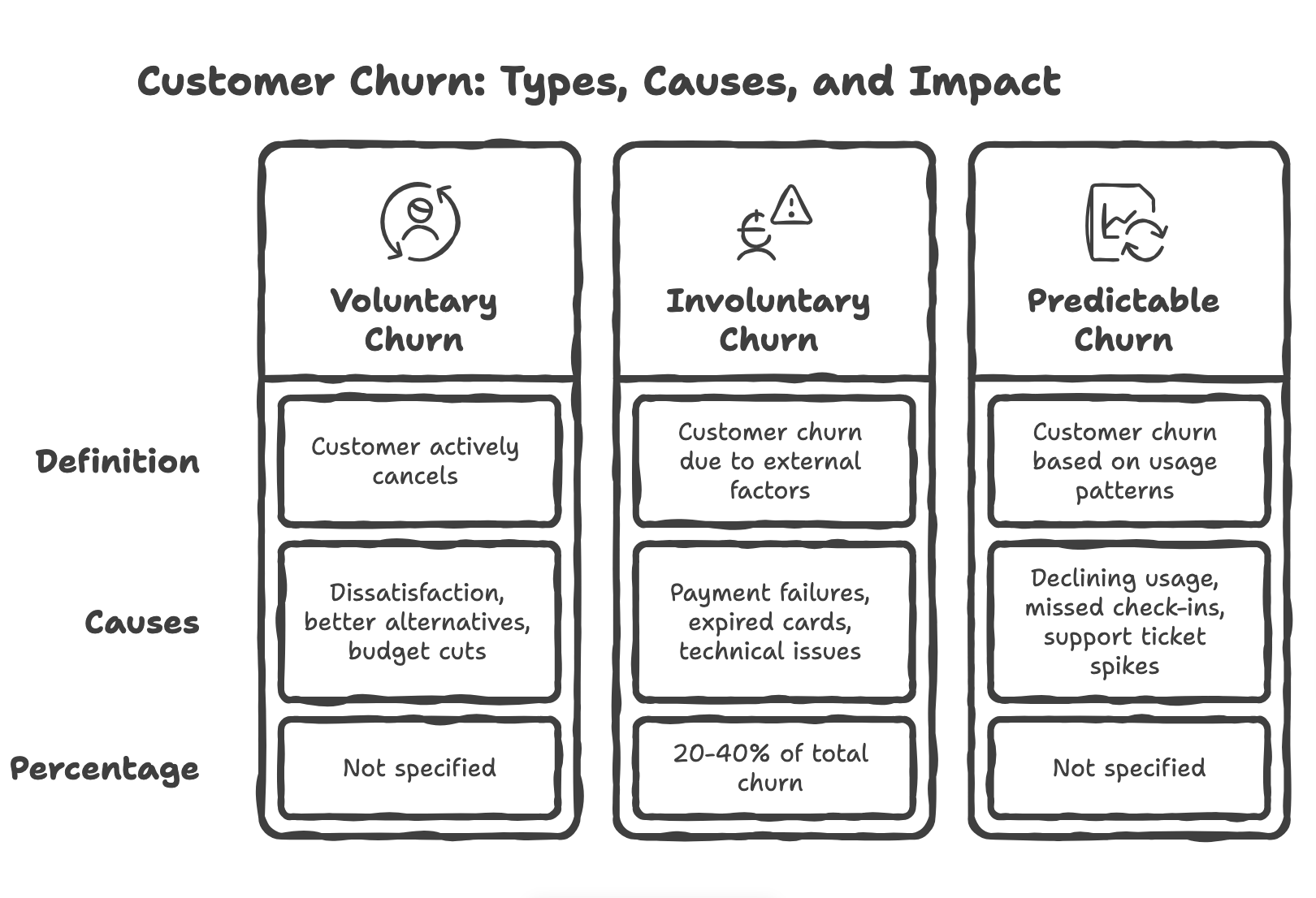
Understanding Churn: Types and Root Causes
- Voluntary Churn — Customer actively cancels due to dissatisfaction, better alternatives, or budget cuts
- Involuntary Churn — Payment failures, expired cards, or technical issues (often 20-40% of total churn, per Gainsight research)
- Predictable Churn — Signals like declining usage, missed check-ins, or support ticket spikes
For a deeper breakdown of each type — plus the formulas to calculate customer churn, gross revenue churn, and net revenue retention correctly — see our companion guide on what customer churn is, the four types that matter, and how to calculate each one.
The Customer Health Score Framework
A health score aggregates multiple signals into a single metric that tells you how likely a customer is to renew. Build yours using product usage, engagement, support ticket frequency, NPS/CSAT scores, and stakeholder activity. Weight each signal based on what predicts churn in your specific business.
The best health score frameworks are calibrated against historical churn data — if you can look back at customers who churned and identify the patterns in the 6 months before they left, those patterns become your leading indicators.
7 Proven Customer Retention Strategies
- Proactive Outreach — Don’t wait for customers to come to you. Reach out at usage dips, milestone moments, and quarterly check-ins.
- Quarterly Business Reviews (QBRs) — Executive-level meetings to review ROI, celebrate wins, and align on next-quarter goals.
- Early Warning System — Set up automated alerts for health score drops, usage declines, or support spikes.
- Champion Mapping — Identify and nurture multiple champions within each account to reduce single-point-of-failure risk.
- Value Documentation — Regularly document and communicate the ROI your product delivers using the customer’s own data.
- Escalation Management — When at-risk signals appear, escalate swiftly and involve senior stakeholders.
- Renewal Playbooks — Create a structured 90-day-before-renewal process covering QBR, commercial review, and success plan update.
Key Retention Metrics to Track
- Net Revenue Retention (NRR) — The gold standard. Above 100% means you’re growing even without new customers. Top-quartile SaaS companies target 120%+, according to data published by OpenView Partners.
- Gross Revenue Retention (GRR) — Revenue retained excluding expansions. Target 90%+.
- Churn Rate — % of customers or revenue lost in a period.
- Customer Lifetime Value (CLV) — Total revenue a customer generates over their relationship.
Related Articles
- What Is Customer Churn? Types, Calculation, and Why It Matters
- Customer Success Metrics: The Ultimate Guide for CSMs
- Effective Renewal and Retention Strategies
- Effective Account Expansion Strategies to Accelerate the CS Lifecycle
- Mastering Difficult Conversations: Proven Conflict Resolution Strategies
- Proactive Customer Management: A Game-Changer for CS Teams
- Customer Success Metrics You Need to Track for Business Growth


Leave a Reply